Pure logic puzzles
Star Battle
Place the stars so every row, every column and every outlined region holds the same number of them, and no two ever touch. One answer, always. No guessing, ever — and the book teaches you every step of the reasoning it asks for.
Start here
How to play
The three rules on a one-star grid, a whole puzzle solved one step at a time, the step up to two stars, and all seven deductions with real worked positions.
Read the methodThe books
Six volumes, one puzzle to a page, wide margins, printed to be written in. Same rules, same five checks — different grids, star counts and levels.
See all sixThe six volumes
Every book is built by the same generator under the same five checks. What changes from one to the next is the grid size, how many stars share a row, and how many levels it grades to — never the rules on the page. Not sure which is yours? Jump to the quick guide.
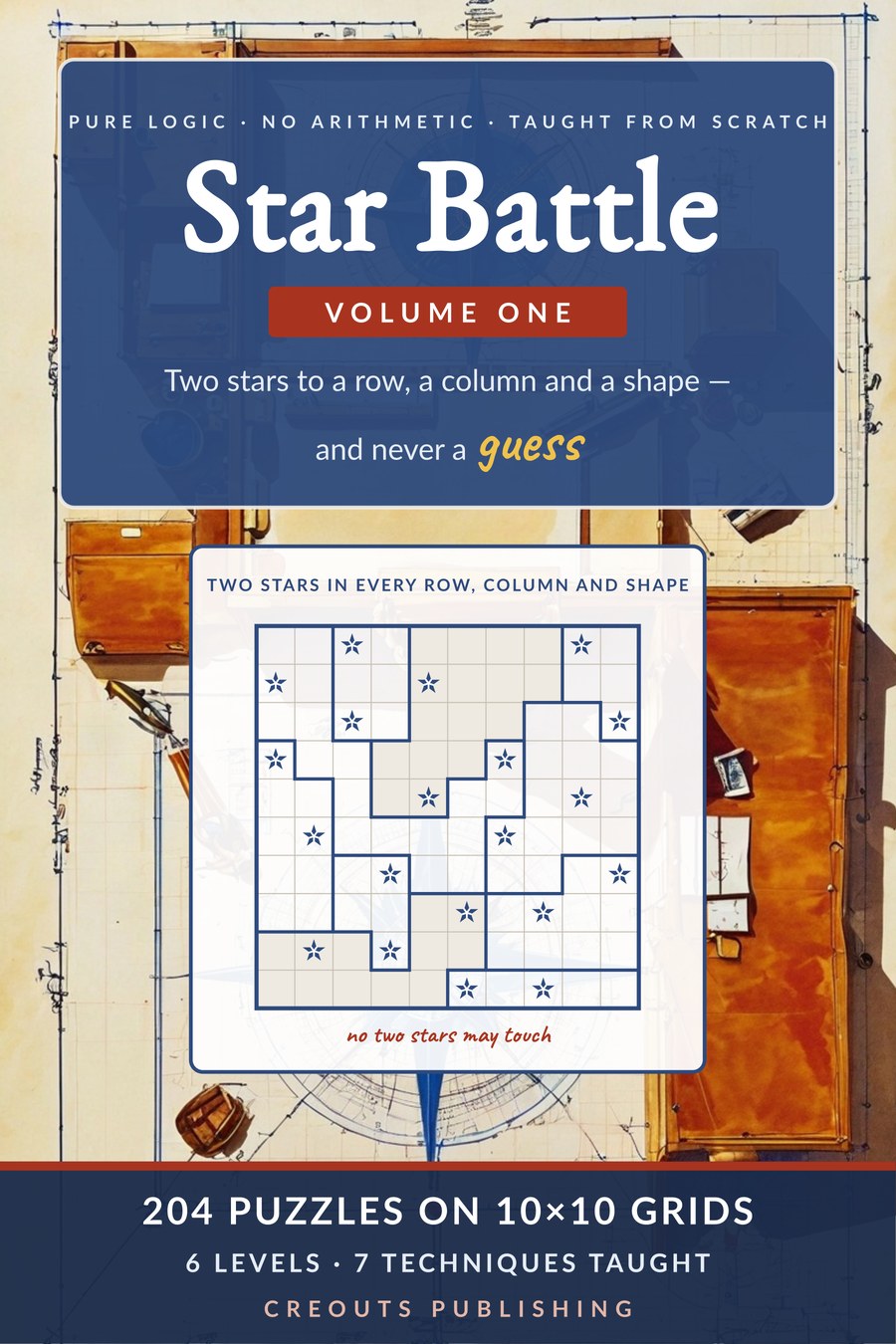
Volume One · Signature · 6×9
The classic 10×10
Start here. 204 puzzles, two stars to every row, column and region, six levels Gentle to Expert — the book the rest of the series is measured against.
- 204 puzzles
- 10×10 grids
- 6 levels
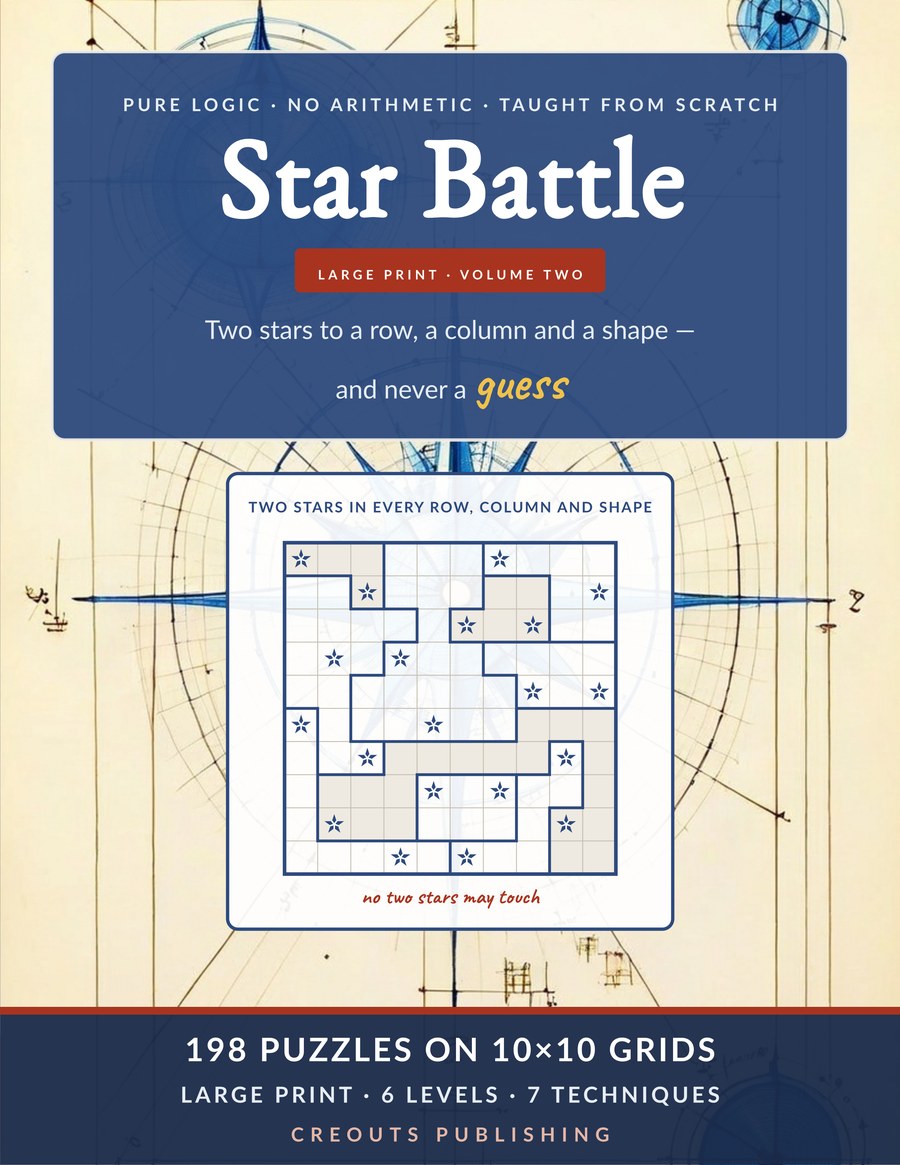
Volume Two · Large Print · 8.5×11
Volume One, bigger
Same puzzles, larger page. The same 10×10, two-star grids and six levels as Volume One, reset in large print with a bigger grid and 16 pt type.
- 198 puzzles
- 10×10 grids
- 6 levels
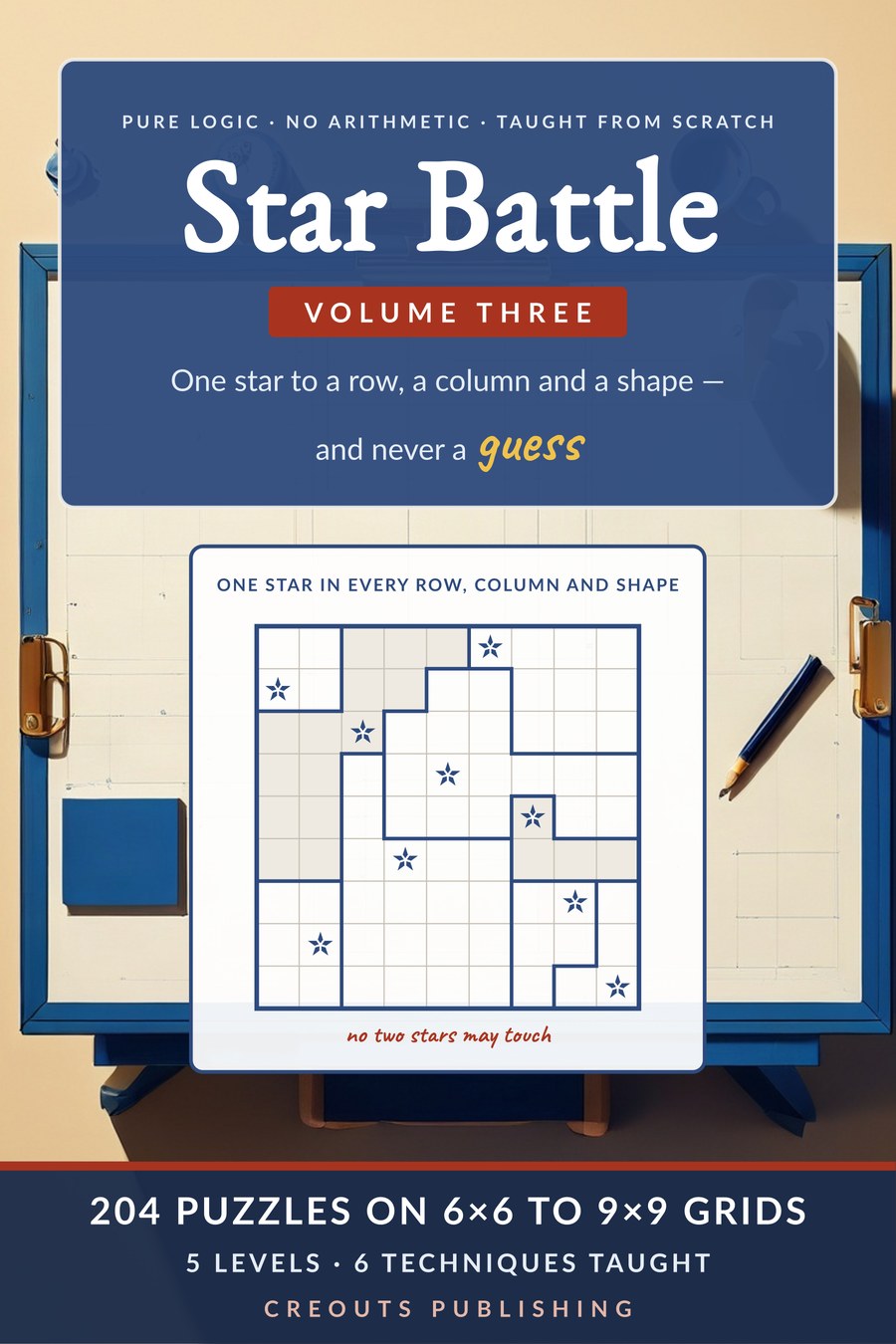
Volume Three · Gentle Start · 6×9
The easy one
Half the density, twice as gentle. Only one star to every row, column and region, on grids that grow from 6×6 up to 9×9. Five levels — there's no Medium at one star.
- 204 puzzles
- 6×6–9×9 grids
- 5 levels
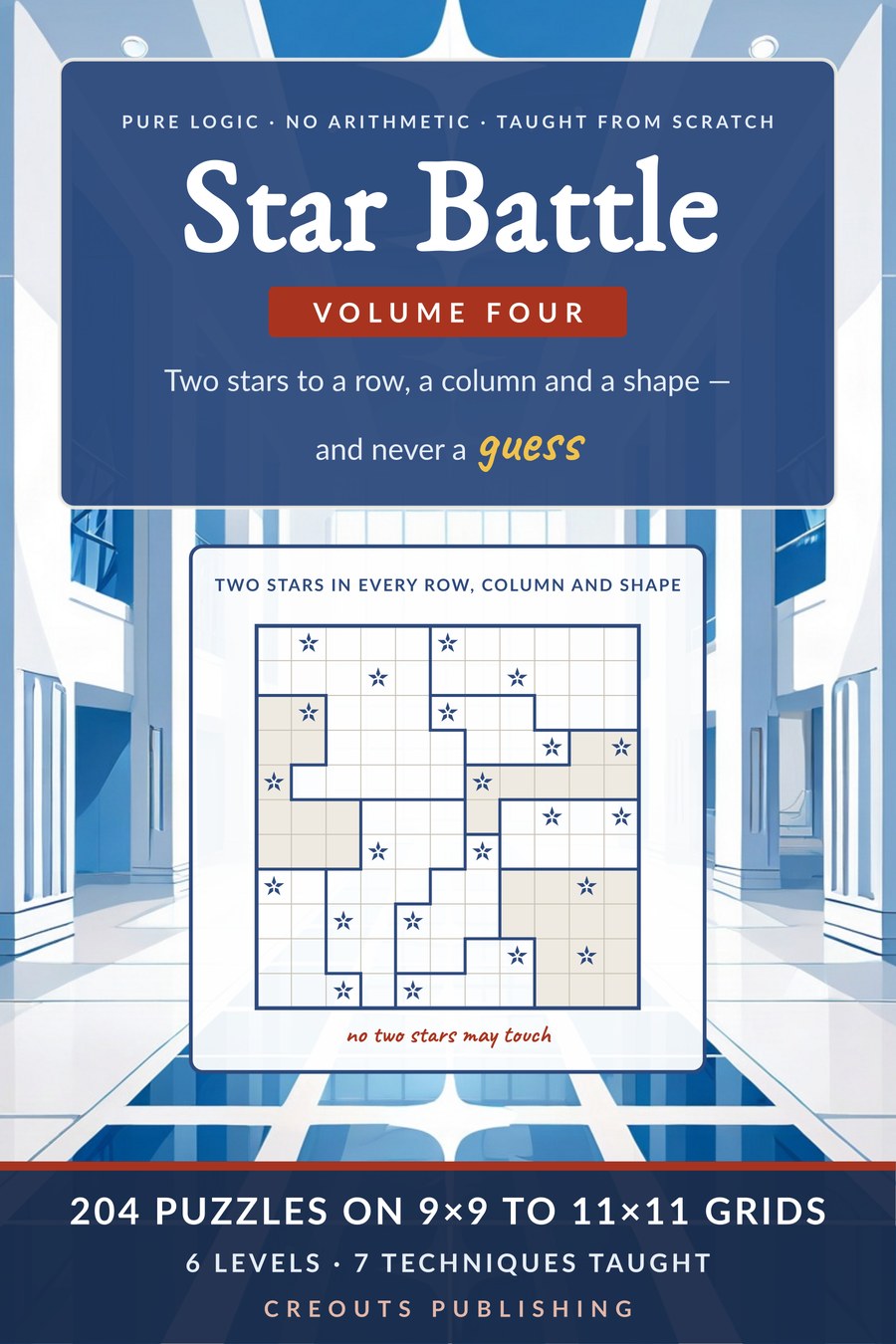
Volume Four · Mixed Sizes · 6×9
The longer game
Volume One's rules, bigger boards. Two stars to every row, column and region, same as Volume One — but the grid itself climbs from 9×9 to 11×11 as you go.
- 204 puzzles
- 9×9–11×11 grids
- 6 levels
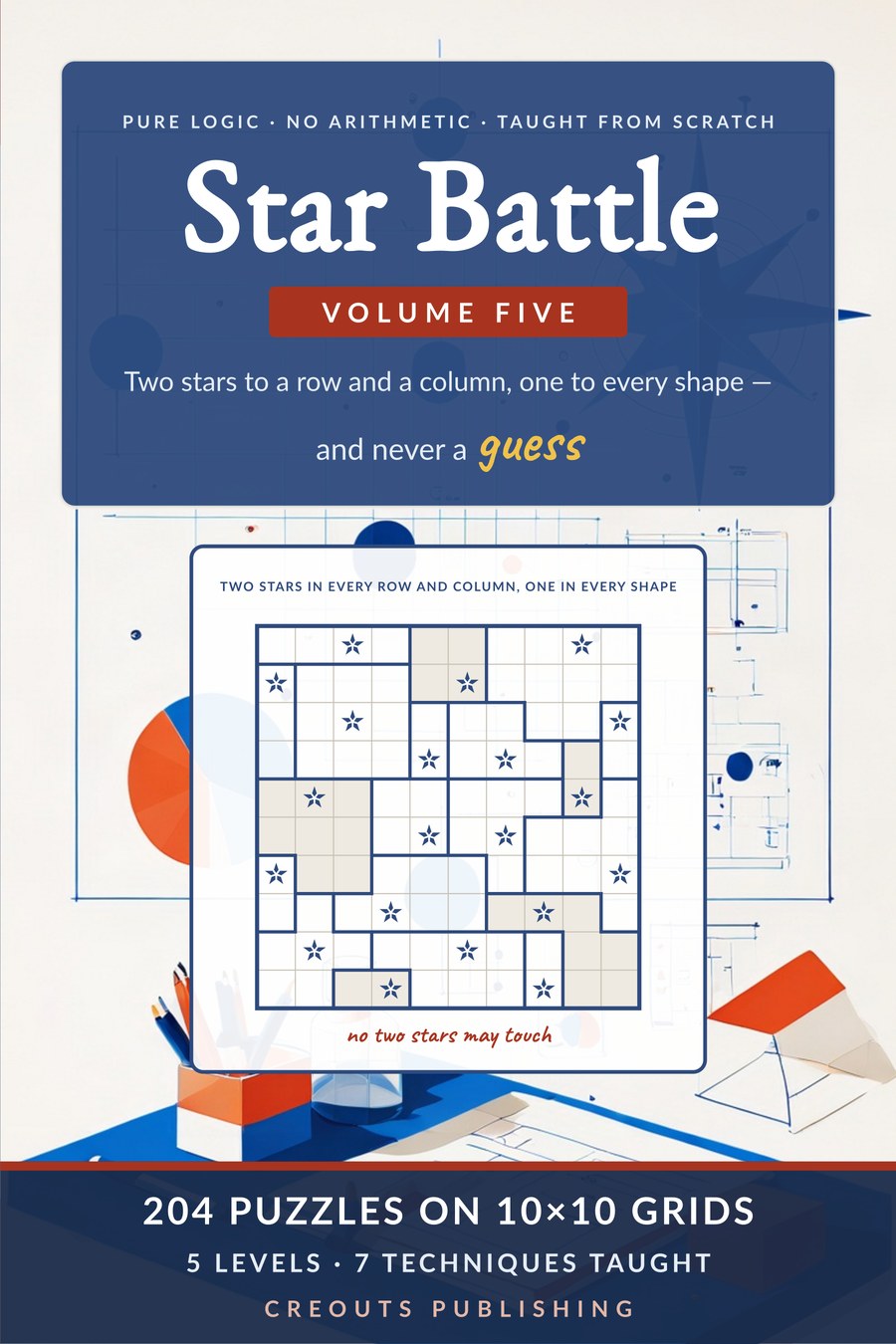
Volume Five · Variants · 6×9
New rules, not new grids
For readers who want a different puzzle. Still 10×10, but two variant chapters: Small Regions (one star per region) and Two Kinds of Star (two colours, each counted separately).
- 204 puzzles
- 10×10 grids
- 5 levels
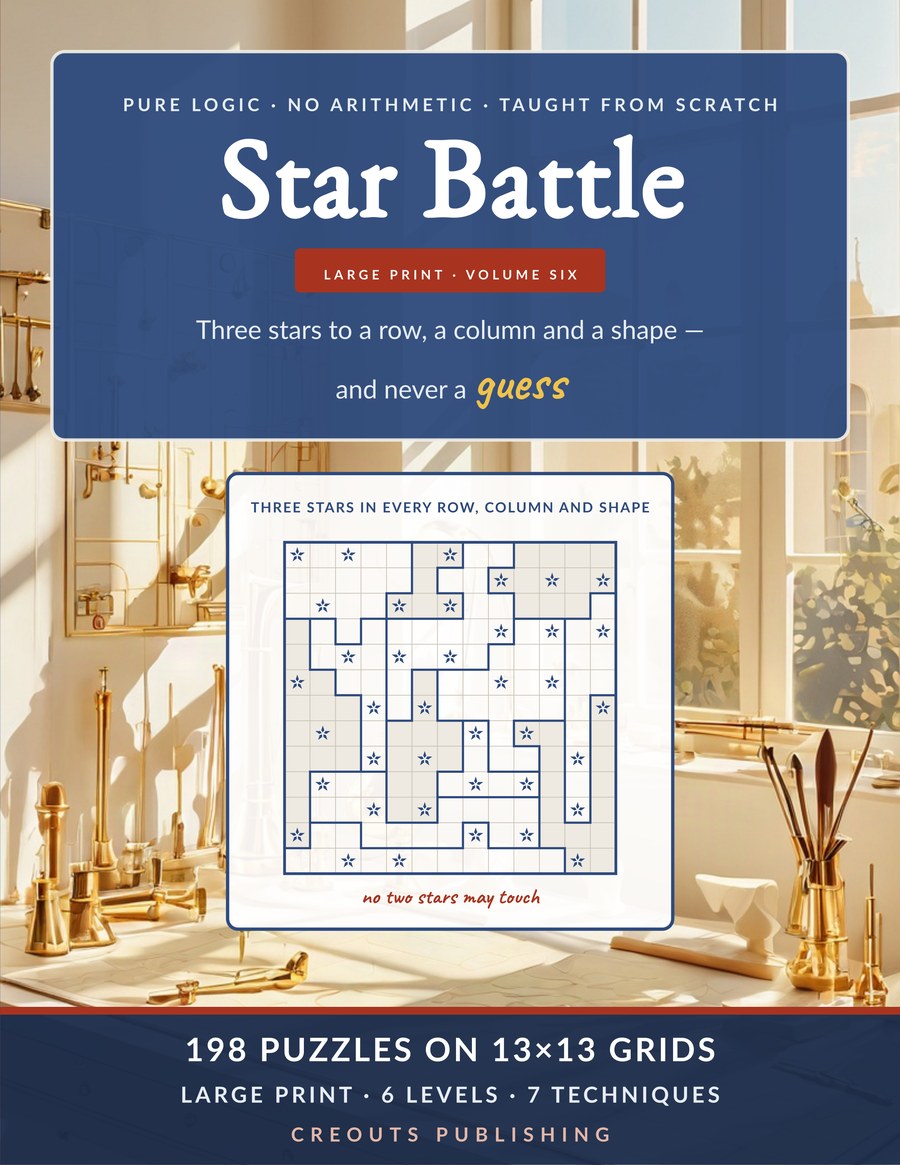
Volume Six · Marathon · Large Print 8.5×11
The biggest puzzle in print
For solvers who've outgrown the rest. 13×13 grids, three stars to every row, column and region — the largest, longest solve in the series, set in large print.
- 198 puzzles
- 13×13 grids
- 6 levels
Which one is for you?
Never solved a Star Battle before, or solving with a child? Start with Volume Three, Gentle Start — one star a row, and the gentlest levels in the series.
Want the puzzle everyone means by "Star Battle"? Volume One, Signature is the 10×10, two-star book the rest of the line is built around.
Need a bigger page to write on? Both large-print books share the same 6-level grading — Volume Two for Volume One's 10×10 grids, Volume Six if you also want the largest, hardest grids in print.
Already finished Volume One and want more of the same? Volume Four, Mixed Sizes keeps the rules and grows the grid, chapter by chapter, up to 11×11.
Finished One or Four and want the puzzle itself to change, not just get bigger? Volume Five, Variants plays two different rule sets on a 10×10 grid.
Looking for the single biggest challenge in the series? Volume Six, Marathon — 13×13, three stars a row, large print.
How our puzzles are made
Every grid passes five checks before it is allowed into a book. They are the difference between a puzzle that rewards careful thinking and one that punishes it.
One answer
Exhaustive search proves every grid has exactly one solution before it is printed.
No guessing
A program forbidden from guessing has to be able to finish it. If it stalls, the puzzle is thrown away, not relabelled.
Honest labels
Difficulty comes from the hardest deduction the solve actually needs — never from a clue count or a stopwatch.
Never twice
Every grid is recorded in a permanent ledger. A puzzle appears once, in one book, in one language, and never again.
Taught, not assumed
Every deduction a book asks of you is taught inside that book, before the first puzzle that needs it.
Star Battle was invented by Hans Eendebak for the 2003 World Puzzle Championship, and has been a championship staple ever since. The genre is free for anyone to publish; the puzzles on this site are our own, generated and checked by our own programs.